

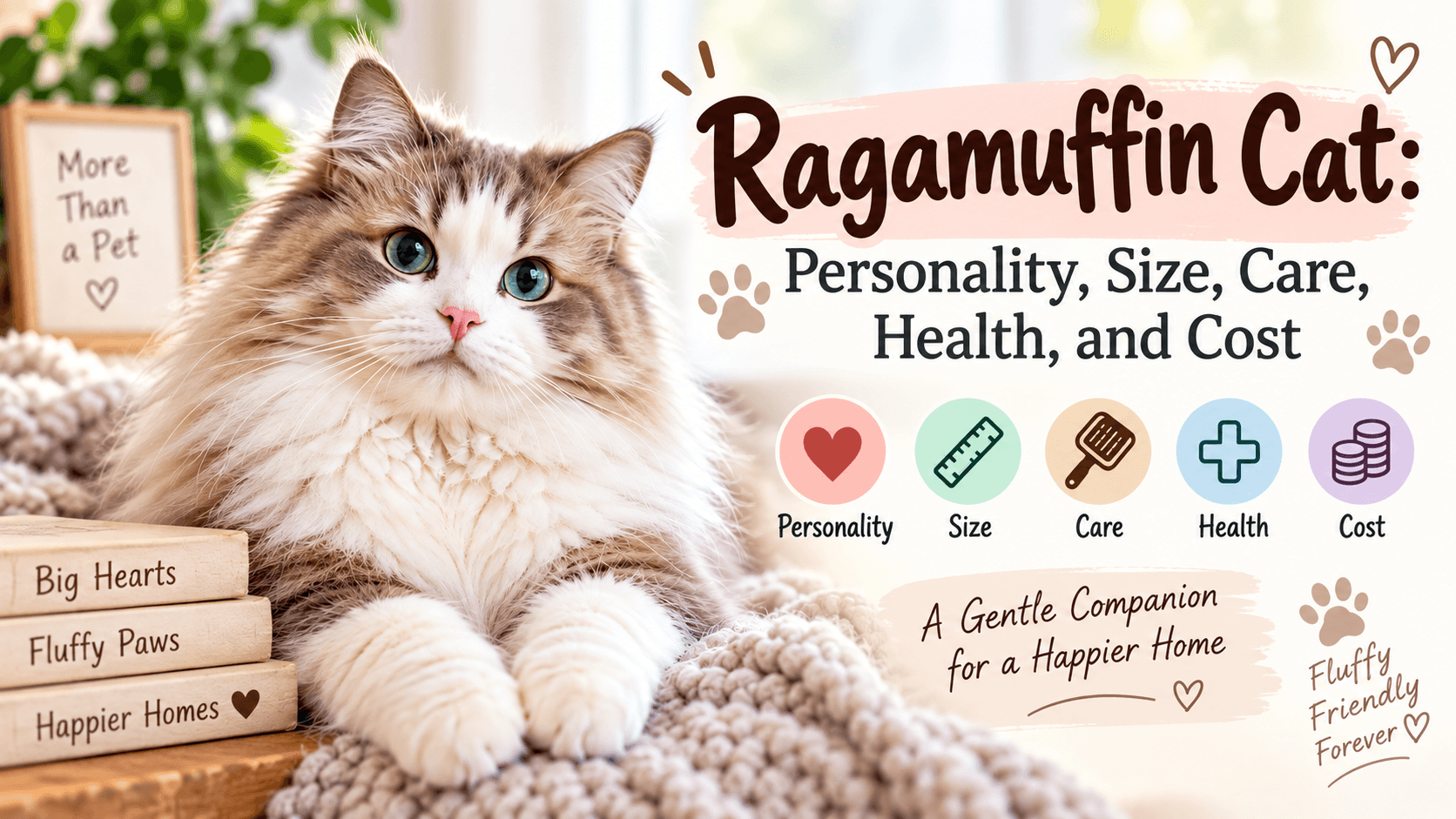
The Ragamuffin is a big, plush, easygoing cat that tends to follow you from room to room and flop into your arms without fuss. That’s the reputation, anyway, and it’s mostly earned. But this is a large, slow-growing, fairly rare breed, and buying one takes more homework than most people expect.
This guide covers what a Ragamuffin is, where it came from, how it differs from a Ragdoll, what it’s like to live with, and what you should budget. It also covers what to ask a breeder before you commit.
What Is a Ragamuffin Cat?
The Ragamuffin is a distinct breed with its own CFA breed standard, recognized at championship level since 2011. It shares ancestry with the Ragdoll, but it isn’t simply a Ragdoll in different colors.
You’ll often see the name written “RagaMuffin,” with a capital M. Breed clubs use that spelling, and the name nods to the street cats of Riverside that made up the original gene pool.
Where the breed came from
Both breeds trace back to Ann Baker’s cats in California in the 1960s. In the early 1990s, a group of breeders separated from Baker’s organization and worked with the full range of her cat lines. They added carefully chosen outcrosses, including domestic longhairs and later Persians, to broaden the gene pool.
The breed name was put forward for a 1994 application to the American Cat Fanciers Association. The milestones since then are easy to lose track of:
- ACFA accepted the breed in 1994 and gave it championship status in 2001.
- CFA granted registration in 2003 and championship status in 2011.
- The GCCF in the UK granted championship status on 17 June 2015.
You may see other dates online, because a few sites mix up the registries. The dates above come from the CFA, the GCCF, and a breed history that traces the ACFA timeline.
What Does a Ragamuffin Look Like?
Picture a heavy, solid cat with a broad face, rounded cheeks, and puffy whisker pads that give it a sweet, slightly surprised expression. The GCCF describes a large, muscular, heavy cat with a dense, silky coat like a heavily furred rabbit, with longer fur around the neck and face and a wispy frill on the hind legs.
Size and growth
Ragamuffins are big, and males are noticeably bigger than females. Females typically weigh 10–15 lb at full maturity, and males commonly reach 15–20 lb. They also mature slowly. The GCCF puts full maturity at around four years. A two-year-old can look fully grown and still be filling out.
Colors and eyes
This is the easiest way to tell them apart from Ragdolls. Ragamuffins can appear in virtually any color and pattern, with eyes in any color. One quirk if you’re thinking about showing: pointed cats can be used for breeding but can’t currently be shown in CFA.
Ragamuffin Personality: What Living With One Is Like
Think of a cat that would rather be in the room with you than anywhere else. They tend to greet family members at the door, follow familiar people around the house, and often go limp when picked up.
They’re not couch ornaments, though. They enjoy playing and climbing scratching posts, and some will chase and retrieve toys. Expect calm, affectionate play rather than the wall-climbing energy of a Bengal or Abyssinian.
Some are also trainable. Because they’re eager to please, some learn tricks like fetching or walking on a leash.
The flip side is that a Ragamuffin doesn’t do well with long stretches alone. If you work long hours away from home and want a cat that’s happy to be ignored, a more independent breed will suit you better.
Ragamuffin vs. Ragdoll
These two get confused constantly, and it’s a fair thing to wonder about. Here’s how they compare:
| Ragamuffin | Ragdoll | |
|---|---|---|
| Colors and patterns | Nearly any color and pattern | Restricted to pointed coloration |
| Eye color | Any color | Blue |
| Coat length | Medium | Semi-long |
| Temperament | Very similar: mellow, affectionate, people-oriented | Very similar |
| Breed standard | Its own, developed by a different group of breeders | Its own |
If you love the Ragdoll personality but want a wider choice of colors, or a cat with a different look, the Ragamuffin is worth considering. If you’re drawn to the blue-eyed pointed look specifically, you’re really shopping for a Ragdoll.
Ragamuffin Health and Lifespan
The good news comes first. The CFA says the breed tends to be sturdy and healthy, with no breed-specific genetic issues, thanks to its diverse background. But it also names two conditions that can occur in any cat, and both are worth knowing about: hypertrophic cardiomyopathy (HCM) and polycystic kidney disease (PKD).
HCM thickens the heart walls, so the heart pumps less efficiently. It’s tricky because many cats show no symptoms in the early stages. That’s why breeder screening matters. Genetic testing of breeding animals usually helps breeders manage these concerns.
As for how long they live, sources give slightly different ranges. One breed database lists 12–16 years, and PetMD says up to 17. Realistically, plan on a bit over a decade, with some reaching their late teens.
A practical note on weight: a big, calm cat that loves food can gain weight quietly. Measuring meals and keeping play in the daily routine helps, and your vet can tell you what a healthy weight looks like for your cat.
Grooming and Daily Care
This is where the breed surprises people. Despite the fluffy look, the coat is thick and plush but doesn’t readily mat or clump, and it’s easy to care for.
- Brushing: A weekly comb-through usually keeps things tidy. Do it more often during heavy shedding seasons.
- Bathing: Most Ragamuffins don’t need regular baths, though an occasional one can bring out the coat’s natural beauty.
- Indoor living: As a general rule, these gentle cats are considered better off mostly indoors, since they may be more vulnerable to outdoor threats than most cats.
- Everyday basics: Nail trims, dental care, a sturdy scratching post, and a tall cat tree suited to a heavy cat.
One more thing to know: Ragamuffins aren’t hypoallergenic. If someone in your household has cat allergies, spend time around the breed before you commit.
Are Ragamuffins Good Family Pets?
Generally, yes. Their patient, tolerant nature suits households with children, and they can get along with dogs too. Introduce pets gradually, as you would with any cat, and teach kids to handle a big cat with two hands and proper support.
They also suit first-time owners well, since the grooming is manageable and the temperament is forgiving. The bigger adjustment for a beginner is the price of getting one and the need for health-tested breeding stock.
Apartments work fine too. A Ragamuffin needs company more than square footage.
How Much Does a Ragamuffin Cat Cost?
Prices vary widely, and honestly they depend on where you live and who’s selling. Here’s what recent sources suggest:
| Source | Typical range |
|---|---|
| Rescue or adoption | $75 to $200 |
| Pet-quality kitten from a reputable breeder | $800 to $1,500 |
| Show or championship lineage | $1,500 to $2,500 or more |
Some sources run higher. One puts the range at $1,500 to $3,500, and notes that many breeders ask for a $300–$600 deposit just to join a waitlist. Treat all of these as rough guides and check with breeders in your area.
Ragamuffins are uncommon in shelters, and mixed-breed cats are sometimes labeled as purebreds. If a kitten’s price seems far below what reputable breeders charge, be cautious. It could be a mix or a scam.
Questions to ask a breeder
A good breeder will welcome these:
- Which health tests have the parents had, and can I see the results? (Ask specifically about HCM and PKD.)
- Are the parents registered with CFA, ACFA, GCCF, or another recognized registry?
- How were the kittens socialized, and at what age do they go home?
- What does your contract say about health guarantees and returns?
- Can I meet the mother, and see where the kittens live?
Most breeders let kittens go home at 14 to 16 weeks, usually vaccinated and often already spayed or neutered.
Who Shouldn’t Get a Ragamuffin
They’re wonderful cats, but not for everyone. A Ragamuffin may be a poor fit if you’re away most of the day, want a low-cost pet, or are hoping for a hypoallergenic breed. And if you’d like a cat that hunts, climbs everything, and keeps itself busy, look elsewhere.
Ragamuffin Cat FAQs
Are Ragamuffins the same as Ragdolls?
No. They share ancestry, but they were developed by different groups of breeders and have separate breed standards. The clearest difference is that Ragamuffins come in nearly any color and eye color, while Ragdolls are pointed with blue eyes.
How big do Ragamuffins get?
Females usually weigh 10–15 lb and males 15–20 lb. They mature slowly, reaching full size around age four.
Do Ragamuffins shed a lot?
They shed like most semi-longhaired cats, more heavily in certain seasons. The coat is unusually resistant to matting, so regular brushing keeps it manageable.
Are Ragamuffins hypoallergenic?
No. If allergies are a concern, spend time with the breed before buying.
Are Ragamuffins lap cats?
Very often, yes. They’re known for going limp when picked up, following their people around, and settling in for a cuddle.
Do Ragamuffins have health problems?
Not breed-specific ones, according to the CFA. But HCM and PKD can occur in any cat, so ask breeders about screening.
Can Ragamuffins be left alone?
Short stretches are fine. Long, regular absences tend to suit them badly, since they bond closely with their people.
How long do Ragamuffins live?
Most sources suggest somewhere between 12 and 17 years, depending on genetics, diet, and veterinary care.
Is a Ragamuffin Right for You?
If you want a big, affectionate, low-drama cat that treats you as the center of its world, a Ragamuffin is an excellent choice. Budget for the purchase price, pick a breeder who health-tests, and be ready to give it time and company. Do those things, and you’ll likely have a devoted companion for well over a decade.
Read more trending stories on INC Gadget.
